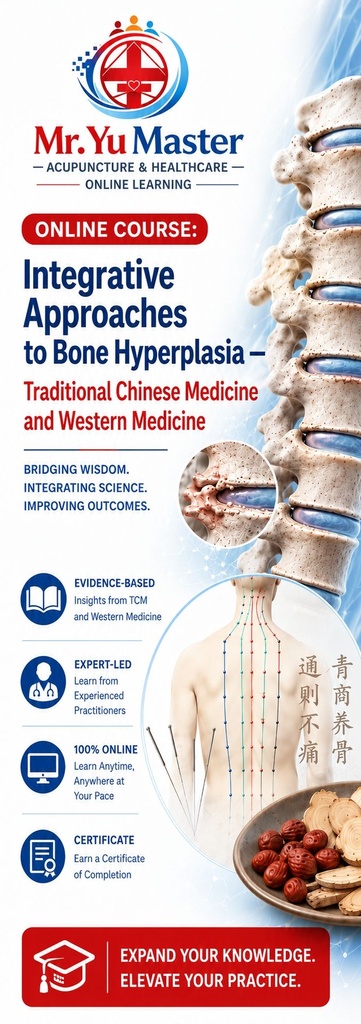
Integrative Approaches to Bone Hyperplasia-Traditional Chinese Medicine and Western Medicine
Course duration: 8.5 hours (8.5 CPD) Course Format: 6 online classes Certificate: Certificate of Completion
Target learners: Acupuncturists, TCM practitioners, physiotherapists, massage/manual therapists, healthcare students, and patients who want structured education.
Important clinical note: In this course, “bone hyperplasia” mainly refers to osteophytes/bone spurs, often related to osteoarthritis, spinal spondylosis, heel spurs, and degenerative joint change. Bone spurs are extra bony growths, usually caused by joint/tissue stress, osteoarthritis, ageing, repetitive strain, or injury. They often cause no symptoms, but may cause pain, stiffness, reduced range of motion, or nerve compression depending on location.
Course Learning Outcomes:
By the end of this course, learners should be able to:
- Explain what bone hyperplasia/osteophytes are from both Western medicine and TCM perspectives.
- Identify common causes, risk factors, symptoms, and red flags.
- Understand effective Western diagnosis, including when imaging is useful and when referral is needed.
- Explain common Western treatments: exercise, weight management, topical/oral NSAIDs, steroid injection, physiotherapy, and surgery when severe.
- Understand TCM pattern differentiation for bone hyperplasia, including Kidney deficiency, Liver-Kidney deficiency, Cold-Damp Bi, Phlegm-Damp obstruction, Qi and Blood stagnation, and Blood stasis.
- Design a safe, evidence-informed TCM treatment plan using acupuncture, electro-acupuncture, moxibustion, cupping, tui na/manual therapy, lifestyle advice, and herbal medicine.
- Explain prevention and long-term self-management strategies.
| Responsible | Victor Yu |
|---|---|
| Last Update | 05/07/2026 |
| Completion Time | 8 hours 37 minutes |
| Members | 1 |
-
Class 1: Understanding Bone Hyperplasia — Causes, Symptoms, and Clinical Meaning (empty)4Lessons · 1 hr 9 mins
-
Class 1-1 What Is Bone Hyperplasia Western Medical Meaning
-
Class 1-2 Bone Hyperplasia - Causes Risk Factors
-
Class 1-3 Bone Hyperplasia - Key Symptoms Signs
-
Class 1-4 Bone Hyperplasia - Red Flags When to Refer
-
-
Class 2: Western Medicine Diagnosis and Clinical Assessment (empty)4Lessons · 1 hr 27 mins
-
Class 2-1 Bone Hyperplasia - History Functional Assessment
-
Class 2-2 Bone Hyperplasia - Physical Examination
-
Class 2-3 Bone Hyperplasia - Imaging Diagnosis
-
Class 2-4 Bone Hyperplasia - Differential Diagnosis
-
-
Class 3: Western Medicine Treatment and Evidence-Based Self-Management (empty)4Lessons · 1 hr 23 mins
-
Class 3-1 Bone Hyperplasia - Education Exercise Weight Management
-
Class 3-2 Bone Hyperplasia - Medication Options
-
Class 3-3 Bone Hyperplasia - Injections Physiotherapy Surgery
-
Class 3-4 Bone Hyperplasia - Prevention Long Term Management
-
-
Class 4: TCM Understanding of Bone Hyperplasia (empty)4Lessons · 1 hr 21 mins
-
Class 4-1 Bone Hyperplasia - TCM Disease Category Pathogenesis
-
Class 4-2 Bone Hyperplasia - Common TCM Patterns
-
Class 4-3 Bone Hyperplasia - TCM Diagnosis Method
-
Class 4-4 Bone Hyperplasia - Treatment Principles
-
-
Class 5: TCM Treatment Methods — Acupuncture, Moxibustion, Cupping, and Herbal Medicine (empty)4Lessons · 1 hr 26 mins
-
Class 5-1 Bone Hyperplasia - Acupuncture Electroacupuncture
-
Class 5-2 Bone Hyperplasia - Moxibustion Cupping TuiNa External Therapy
-
Class 5-3 Bone Hyperplasia - Herbal Medicine
-
Class 5-3 Bone Hyperplasia - Herbal Medicine
-
-
Class 6: Integrative Case Management and Prevention (empty)4Lessons · 1 hr 21 mins
-
Class 6-1 Bone Hyperplasia - Knee OA Case Study
-
Class 6-2 Bone Hyperplasia - Cervical Lumbar Bone Hyperplasia
-
Class 6-3 Bone Hyperplasia - Patient Education Prevention Plan
-
Class 6.4 Final Review and Assessment10 xp
-
-
Final Quiz (empty)1Lessons · 30 mins
-
Final Quiz and Course Completion Certificate
-